Theme Park Turnstiles and Entry for Larger Guests: Which Parks Use Them and How to Ask for the Wide Gate
Turnstiles can't be the only way into a park under federal accessibility rules, so there's always a wider gate. Here's which parks use turnstiles in 2026 (Disney World doesn't), where the wide lanes are, and exactly what to say to use one.
Sarah · November 22, 2026 · 8 min read
For a lot of plus-size guests, the first stressful moment of a park day isn't a coaster. It's the front gate. Three-arm turnstiles can be tight for wide hips, a big belly, or a broad frame carrying a backpack, and nobody wants to get stuck with a line behind them. Here's the good news: under federal accessibility rules, a turnstile can't be the only way in, so every park with turnstiles also has a wider gate. Some parks, including Walt Disney World, dropped entry turnstiles years ago. This guide covers which parks use what in 2026, where the wide lanes are, and exactly what to say to use one.
Quick answer
- Turnstiles can't be the only way in. The 2010 ADA Standards (404.2.1) say revolving gates and turnstiles "shall not be part of an accessible route." Parks that use turnstiles also have a wider gate or lane.
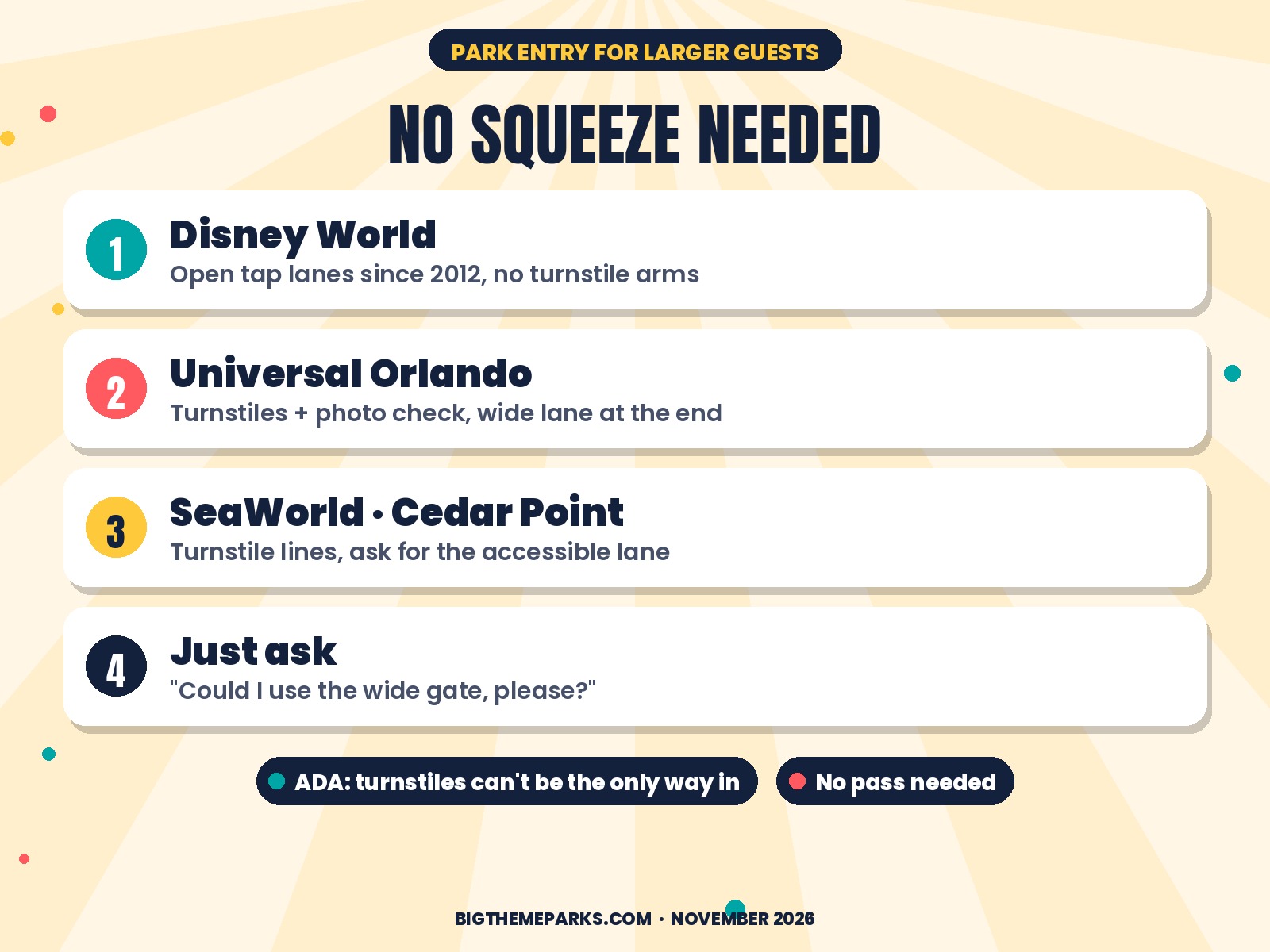
- Walt Disney World has no entry turnstiles. Disney replaced them in 2012 with open "touch to enter" lanes. You tap your MagicBand, card, or phone at a pedestal and walk through. No bar to push.
- Universal Orlando uses entrance turnstiles with photo validation cameras, according to TouringPlans. Wheelchair users get through, and so can you.
- SeaWorld Orlando's 2026 accessibility guide says guests using wheelchairs or ECVs may use any ticketing or turnstile line. That tells you there are wider options at the gate.
- Cedar Point refers to its "front gate turnstiles" on an official 2026 event page.
- How to ask: Walk up to the attendant at the end of the turnstile row and say, "Could I use the wide gate, please?" You don't need to explain or show anything.
- Turnstiles inside parks show up at some ride entrances and attraction queues too. The same request works there.
Why turnstiles are tight, and why there's always another way
A standard three-arm turnstile has a fixed opening. You walk into the space between the arms, push the arm in front of you, and rotate through. Hips, belly, a wide backpack, or a stroller can all hit the arms or the side housing. Taller riders sometimes bang their thighs on the arm.
That's not just a plus-size problem. Wheelchair users, people with walkers, parents with strollers, and guests with service animals can't use a turnstile either. That's why the ADA's accessible-route standard rules them out as the only path. In practice, nearly every turnstile bank has a swing gate, an open lane, or an attended wide lane at one end. It's usually marked with an accessibility symbol, and sometimes there's a stroller or wheelchair sign.
So you're not asking for a favor or a special exception. You're asking to use a lane that's built into the entrance for exactly this reason.
Walt Disney World: tap lanes, not turnstiles
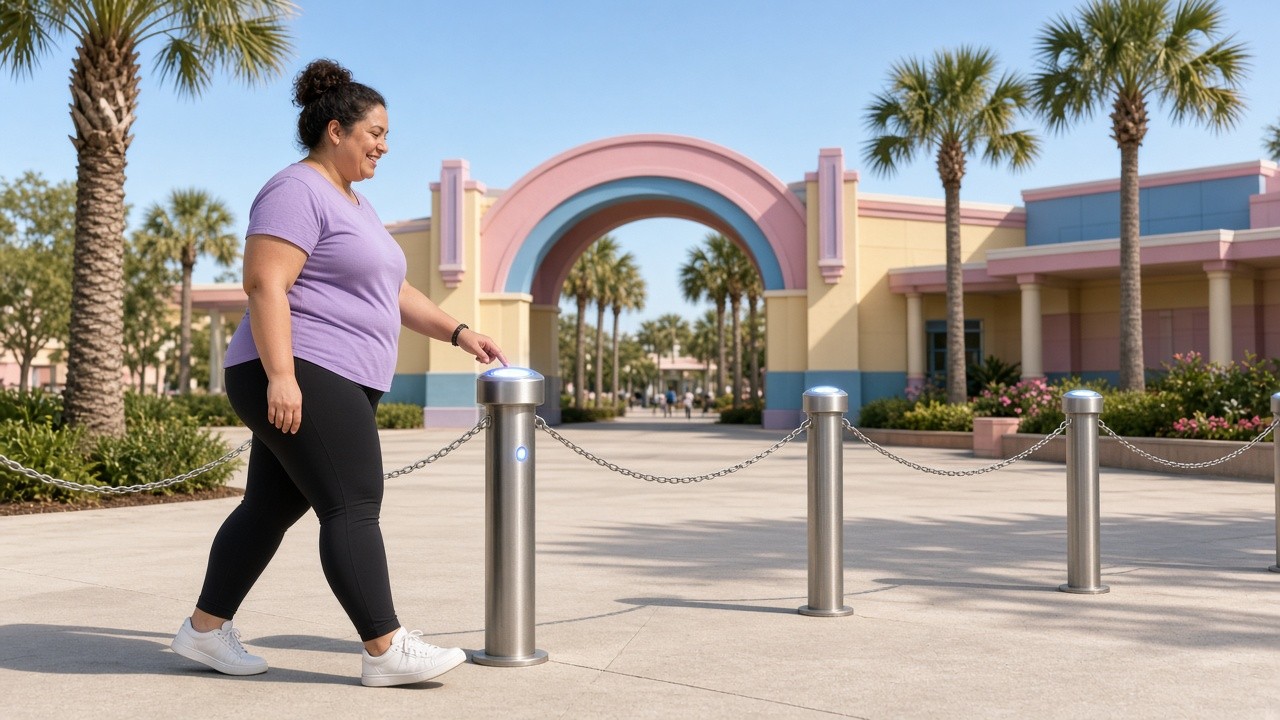
Walt Disney World removed its entry turnstiles in late 2012, NBC News reported at the time. Disney switched to open lanes with "touch to enter" pedestals. Today you tap a MagicBand, park ticket card, or your phone, complete the identity check the lane asks for, and walk through. There's no rotating arm.
For larger guests, that means the Disney front gate is usually the easiest entry in Orlando. Lanes are open on both sides, and Cast Members can direct wheelchairs, ECVs, and strollers to the wider lanes.
What might change: In October 2026, WDW Magic and WDW News Today reported a rumor that Disney World may adopt the automated entry gates Disneyland has used since 2025. At Disneyland, you scan, a camera takes your photo, and a gate swings open. Disney hasn't announced any change for Florida. If gates do arrive, expect wider accessible lanes to stay, as they have at Disneyland.
Inside the parks: A few Disney attractions have turnstiles at the queue entrance. A July 2026 plus-size guide from Pixie Dusted Journeys described one at Walt Disney's Carousel of Progress (closed for refurbishment until spring 2027). The author simply asked a Cast Member to let her through the chained-off side.
Universal Orlando: turnstiles with photo validation
Universal Orlando uses entrance turnstiles. Since at least April 2025, it has used photo validation to match tickets to guests. TouringPlans reported that the cameras sit "in the black bar above the screens at the turnstiles." The system works for guests in wheelchairs, and you can opt out at the entrance turnstiles or at Guest Relations.
For larger guests:
- Look for the wider lane at the end of each turnstile bank. Team Members use it for wheelchairs, ECVs, and strollers.
- Ask the nearest Team Member before you scan: "Can I come through the wide lane?" They'll scan your ticket there.
- If you have a big backpack, take it off and carry it in front of you before you hit a standard turnstile. It's often the bag, not your body, that catches.
The same applies at Epic Universe, Universal Studios Florida, and Islands of Adventure. If you're heading there, our Universal Orlando ride-fit guide covers what happens after the gate.
SeaWorld, Cedar Point, Kings Island, and other parks
SeaWorld Orlando. The park's May 2026 accessibility guide says guests using wheelchairs or ECVs may join any ticketing or turnstile line. Ask the entry team for the widest lane.
Cedar Point. The park's official military days page mentions its "front gate turnstiles." Cedar Point doesn't publish a gate layout, so ask a team member at the front gate for the accessible or stroller lane. Our Cedar Point ride-fit guide covers the rides themselves.
Kings Island. We couldn't confirm from a current official source whether the Kings Island front gate uses turnstiles or open lanes in 2026. Plan as if there might be turnstiles: look for the accessible lane and ask if you're unsure. Our Kings Island ride-fit guide covers the coasters.
Everywhere else. Most big parks, water parks, stadiums, and zoos follow the same pattern: turnstiles or tap lanes, plus at least one wider lane for wheelchairs and strollers. If you can't spot it, ask the person scanning tickets.
How to ask for the wide gate (without making it a thing)
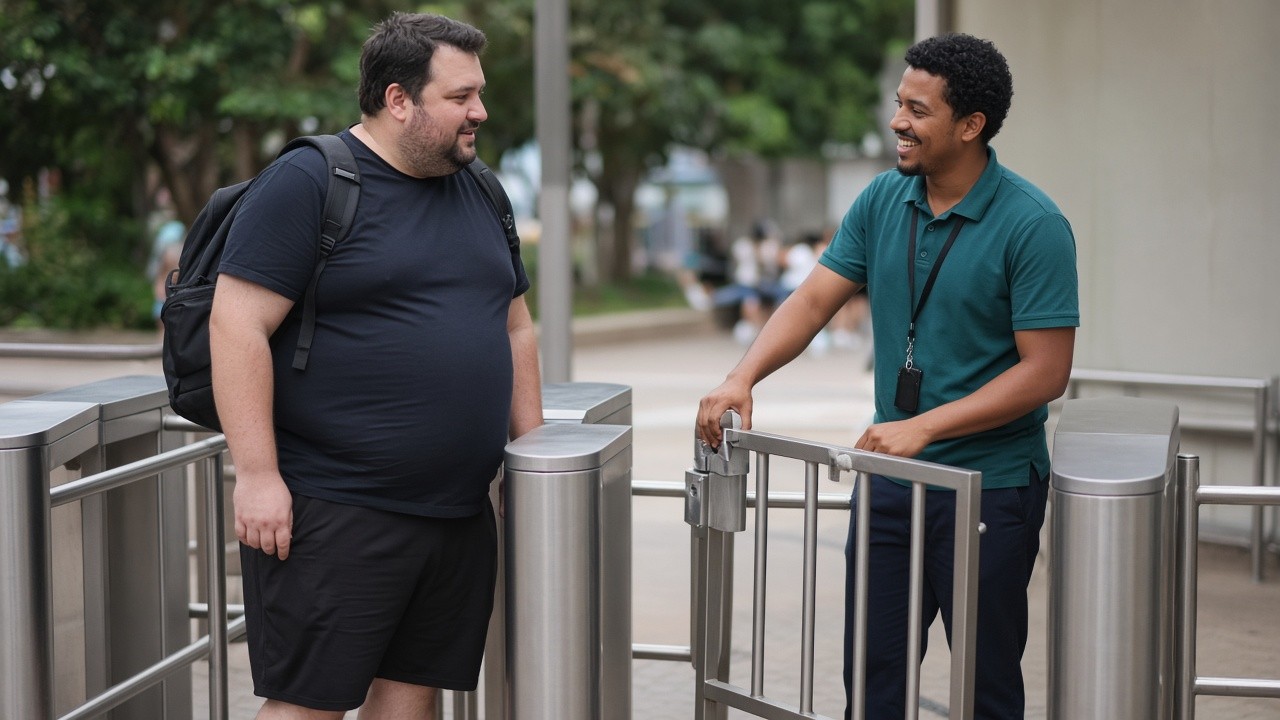
Most staff open the wide gate dozens of times a day. Here's how to keep it quick and low-key:
- Scan the entry area as you walk up. The wide lane is usually at one end of the turnstile row. Look for a swing gate, a wheelchair or stroller symbol, or an attendant standing at a podium.
- Get in that line, or the line next to it. If there's an obvious accessible lane, join it.
- Keep it short. "Hi, could I use the wide gate, please?" That's enough. You don't have to explain your body, show a disability pass, or apologize.
- Have your ticket ready. At most parks the attendant scans you right there. At Universal, the photo step happens at the scan point.
- If someone hesitates, say, "The turnstile is too narrow for me." Entry staff open that gate all day for wheelchairs, strollers, and anyone who can't use a turnstile.
A few extras that help:
- Bring a smaller bag. A crossbody or slim backpack you can swing to the front makes any gate easier.
- Go through security first, then look for the wide lane. Bag check and entry are often separate.
- Rope drop crowds make the gate area hectic. Arriving 10 to 15 minutes before the main rush gives you room to find the right lane.
Turnstiles inside the park: queues and ride entrances
Turnstiles aren't only at the front gate. You may also find them at:
- Ride entrances, to meter the line. Some older attractions still use them, like the Carousel of Progress example above.
- Other attended entry points, such as some water park, event, or gated-area entrances. Policies and layouts vary, so look before you line up.
The same rule applies: ask the attendant for the side gate. At ride entrances, this is also a good moment to check fit. Many parks let you check a real restraint at the exit before you queue. Our test-seat guide explains how.
And if you're planning where to go, our list of the best US theme parks for plus-size, tall, and broad-shouldered riders covers which parks are easiest overall.
FAQ
Does Disney World have turnstiles? Not at the main entrance. Walt Disney World replaced its entry turnstiles in 2012 with open "touch to enter" lanes where you tap a MagicBand, ticket, or phone and walk through. A few attractions have turnstiles at the queue entrance.
Does Universal Orlando use turnstiles? Yes. Universal's entrances use turnstiles with photo validation cameras. There's a wider lane for wheelchairs and strollers, and you can ask a Team Member to use it.
What if I don't fit through a theme park turnstile? Ask the attendant for the wide gate. Under the 2010 ADA Standards, turnstiles can't be part of an accessible route, so parks with turnstiles also have a gate or lane that opens wider. You don't need to explain or show anything.
Do I need a disability pass to use the wide gate? No. The wide lane is there for anyone who can't use the turnstile, including guests with strollers and wheelchairs. A simple request is enough.
Are theme park turnstiles weight-restricted? Parks don't publish weight limits for turnstiles. The real issue is the width of the opening, which is why the wide gate is the answer.
Sources
- 2010 ADA Standards 404.2.1: Revolving doors, gates, and turnstiles
- NBC News: Disney World's turnstiles vanishing (2012)
- WDW Magic: Park tap points could be replaced (October 15, 2026)
- WDW News Today: Rumor on Disneyland-style entrance gates (October 2026)
- TouringPlans: Photo validation now at Universal Orlando (April 2025)
- SeaWorld Orlando Accessibility Guide (PDF, May 2026)
- Cedar Point: Military Days
- Pixie Dusted Journeys: Plus-size guide to Magic Kingdom (July 2026)